
More than Calaries: Food Access Meets More than Physical Needs
- Matthew C. Walker

- 5 hours ago
- 4 min read

Food access and food security meet more needs than simply filling an empty stomach. At the most basic level, access to food prevents starvation. Having food of any kind is better than having none. However, having access to nutritious food, rich in fiber, vitamins and minerals does more than prevent hunger. It reduces the risk of malnutrition and related health conditions and supports long term well being.
Beyond that, having access to nutritious food that you enjoy, that has been prepared with care and offered with dignity, can provide all of that in addition to something less measurable but important none the less. A sense of welcome, connection, and community. In those moments the food meets not only physical needs, but psychological ones as well.
This is one of our guiding philosophies at Boarding Axe Kitchen, and something that we observed when we started our early work with food shelves. People would utilize food shelves, pantries, banks, soup kitchens and other nutrition access areas to have needs met. Those needs were not always limited to food. Sometimes they were social. Sometimes they involved accessibility. Sometimes it was just about being seen, welcomed and treated with kindness. What would happen at the access areas was rarely just a transactional exchange of edible items. It was a meeting of human needs.
That understanding shapes how we cook. We pay close attention to plating, garnishes and presentation. Not because appearance matters more than nourishment but because care is visible. We also make deliberate choices about variety. When possible, we prepare food that spans breakfast, lunch, dinner, snacks and deserts. Foods that recognize people arrive with different needs, preferences and circumstances.
Over time that has meant making pies and cakes, cookies and breads, plus other foods that might not be considered essential in a narrow sense but still meet real needs all the same. Familiar foods, treats and shared staples can provide comfort, choice and a sense of normalcy alongside nourishment. It is the same reason that we favor prepared foods. They meet a different set of needs. They don't replace the current food access systems, they suppliment them.


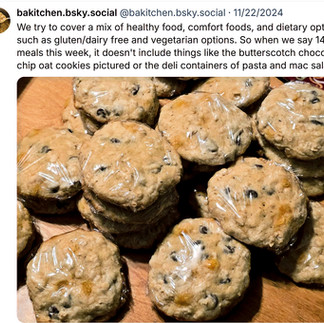


(Each image shown is a screenshot from an earlier Bluesky post documenting examples of prepared foods outside of the strict 'meals' category)
If food access were only about calories, our advocacy could be reduced to a mathematical equation. The most efficient use of resources would be to provide nothing but dried rice and beans, maximizing only the sheer number of people fed. But food access does not exist in a vacuum.
A family displaced by a fire or storm, without a stove or cookware, can do very little with dried beans alone. Prepared foods are accessible in ways raw ingredients are not. Preparation requires time, tools, skill, and physical ability which are not resources everyone has available to them at all times.
Elderly individuals, people who are injured or disabled, or those living with chronic illness may be better served by foods that do not require extensive preparation. Hands stiffened by age or illness can struggle with jar lids and can openers. For those same individuals, prepared meals can support dignity and independence by removing barriers rather than adding them.
That is why we grow parsley and basil in the summer for garnishes, and why we make pasta salads, potato salads, and other dedicated side dishes alongside main meals. It is also why we bake cakes and cookies that are intended to do nothing more than bring comfort and joy to the people who receive them. These choices are deliberate. We try to operate in a way that allows the food we prepare to meet more needs than simply the transactional provision of calories.
Food preparation is only one part of our programming. As we work to establish our Content-to-Community-Impact loop, we also produce food-related content in the form of images, written recipes, and videos. In addition, we publish educational material focused on reducing food waste, promoting food preservation, and using ingredients commonly distributed by food access organizations such as canned fruits and vegetables, canned proteins, and pantry staples like dried pasta, rice, and beans.
These educational resources are published across our blog, Amuse-Bouche, Advocacy, and Audacity, and are identified using the “Community” tag. This content may include recipes designed to reuse leftovers and extend the impact of available food (such as our recipe for Turkey Salad), as well as recipes built around shelf-stable ingredients commonly found in food shelves and household pantries. Some of those recipes are even the exact recipes that we used to prepare food that was distributed to the community like our Chicken Macaroni Salad.
This is the work behind “Food Supporting Food” as outlined in our Support page. The meals we prepare, and the knowledge we share about how and why they are made, are meant to reinforce one another so that care, access, and dignity can extend beyond a single kitchen or a single meal.

Comments